Arranging corporate bus hire for a conference is straightforward when you work through the right steps in the right order — this guide covers exactly that, from headcount to handover on the day.
TL;DR: To arrange corporate bus hire for a conference in 2026, confirm your headcount and pick-up locations first, then request quotes at least 3–4 weeks out, choose the right vehicle size, lock in a run sheet, and brief your driver the day before. Foxbus handles corporate bus hire across Sydney and other major Australian cities with upfront pricing and no hidden fees.
Conference transport fails in predictable ways: the vehicle is too small, pick-ups run late because no one mapped the stops, or the booking is left too late and the right vehicle size is unavailable. A structured approach fixes all three. The steps below are ordered by when each decision needs to happen, not by importance — every one of them matters.
Confirm numbers before you do anything else.
Every other decision — vehicle size, cost, number of runs — depends on how many people you're moving. Don't go off the RSVP list alone; add a 10% buffer to account for late registrations and walk-ins. Also note whether your group includes executives who expect a higher-spec vehicle, or whether a standard coach is fine for all attendees.
A group of 20 needs a different vehicle to a group of 52. Getting this wrong means rebooking or, worse, leaving people behind on the day. In 2026, most operators require a minimum passenger count at the time of quote — have a number ready.
Common mistake: Using the conference registration cap as your transport number. Actual attendance is almost always lower. Confirm with the event manager 5 days out and adjust your booking if your operator allows it.
List every stop the bus needs to make, in order.
For a conference, the typical run looks like this: hotel or CBD meeting point → conference venue → (optional) lunch or offsite activity → hotel or station at close. If delegates are flying in, you may also need an airport leg. Write out each stop with the full address, not just the suburb.
Once you have the route, check whether a single vehicle can service it efficiently or whether you need two smaller vehicles running parallel routes. A 45-minute gap between the first and last pick-up usually means splitting into two runs is cheaper than making everyone wait.
Expected outcome: A clear route card you can hand directly to the operator when requesting a quote. This also reduces quote errors — operators price on distance and time, so a vague route produces a vague price.
For events involving airport arrivals across multiple flights, the guide on how to plan airport transfers for large groups covers scheduling logic in detail.
Match the vehicle to your confirmed number, not your maximum capacity.
Running a 57-seat coach for 18 people wastes money and feels odd for a corporate setting. Here's a quick reference for 2026:
| Passenger count | Vehicle type |
|---|---|
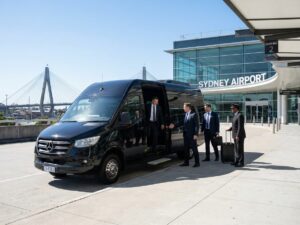
| 8–12 | Minibus |
| 13–24 | Mid-size minibus |
| 25–35 | Small coach |
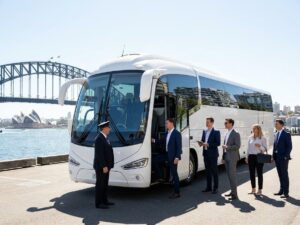
| 36–57 | Standard coach |
| 58+ | Large coach or multiple vehicles |
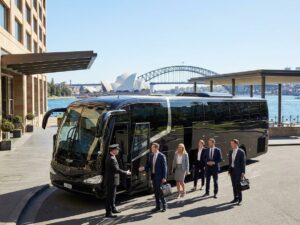
For executive groups or C-suite delegates, ask specifically about executive coach options — these typically include leather seating, extra legroom, and a cleaner interior presentation, which matters when you're transporting senior clients or interstate guests.
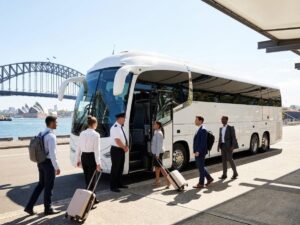
Common mistake: Booking by seat count alone without checking the luggage space. If delegates are arriving from interstate with bags, a fully seated vehicle with no hold space creates a problem.
Get your quote at least 3–4 weeks before the conference date.
Corporate conference season in Australia clusters around March–May and August–October. During those windows, quality operators fill their fleet quickly. Leaving the booking to the week before the event risks getting a vehicle or driver that wasn't your first choice.
When you contact an operator, give them:
Foxbus provides instant online quoting through foxbus.com.au/corporate-bus-hire for corporate bookings across Sydney, Melbourne, Brisbane, Canberra, and other major cities — you get a fixed price upfront, not an estimate that changes at invoice.
Once the quote matches your brief, pay the deposit to secure the vehicle. Most operators hold a booking for 24–48 hours without a deposit, but no longer.
Common mistake: Accepting a quote without confirming the vehicle is air-conditioned and the driver holds a current heavy vehicle licence and operator accreditation. Ask both questions explicitly.
A run sheet is the single document that keeps the whole day on time.
A conference run sheet for bus hire should include:
Send the run sheet to the operator at least 48 hours before the event. A good operator will review it and flag any timing that looks unrealistic given traffic conditions — take that feedback seriously. Sydney CBD peak hour adds 15–25 minutes to most cross-city routes in 2026.
Expected outcome: The driver arrives with the route pre-loaded, timing confirmed, and no need to call you on the morning for directions.
Someone at the conference needs to own the transport on the day — and it should not be the same person running the event program.
Appoint a transport coordinator whose only job on the day is to manage bus departures: counting passengers, communicating delays to the driver, and handling any last-minute changes. Give them the operator's direct line and the driver's mobile number.
If the conference runs multiple sessions with different departure windows, print a simple one-page schedule for your transport coordinator. Do not rely on them remembering verbal instructions given the morning of a busy event.
Common mistake: Assuming the driver will manage group wrangling. Drivers drive — they are not responsible for rounding up delegates who are still at the networking drinks.
A one-minute call the afternoon before the event prevents the most common day-of problems.
Call or message the operator to confirm: vehicle type, driver name, first pick-up time, and first pick-up address. Ask the operator to confirm the driver has the run sheet. This is also when you flag any last-minute headcount changes — most operators can adjust within 10–15% without a contract change.
In 2026, some operators also send a driver confirmation SMS automatically. If yours does, cross-check that the details match your booking exactly before replying confirmed.
The vehicle is the wrong size on the day.
Contact the operator immediately. Reputable operators carry backup vehicles or can redirect a vehicle from another job. This is why booking with an established fleet operator — not a sole trader with one bus — matters for corporate events.
Pick-ups are running late.
Call the driver directly, not the office. Give a revised departure time and ask them to hold. If the delay is more than 20 minutes, notify the conference organiser so the program can flex.
A delegate has accessibility needs that weren't flagged at booking.
Most standard coaches have steps. If a wheelchair or mobility aid is involved and wasn't declared at booking, call the operator as early as possible — ideally weeks out — so they can assign an accessible vehicle. Last-minute requests may not be fulfillable.
The driver doesn't have the run sheet.
Text the run sheet directly to the driver's mobile. Keep a printed copy with your transport coordinator as backup.
The conference runs long and the bus departure is missed.
Build a 30-minute buffer into the return leg at the time of booking. Tell the operator the conference ends at 5:00 pm even if it officially closes at 4:30 pm. That buffer costs nothing and prevents stranded delegates.
You need an extra vehicle on short notice.
For last-minute additions, go directly to the operator you already booked with — they may have availability or a partner fleet. Searching cold for a new operator under time pressure increases the risk of getting an unaccredited vehicle.
If your conference is within the next 6 weeks, request a quote today — don't wait. Use the corporate bus hire page to get a fixed price online in minutes. If you're planning further out, use this guide to draft your run sheet now while the logistics are still flexible.
For events that involve multiple corporate outings across the year, ask Foxbus about account arrangements — repeat corporate clients in 2026 typically get priority vehicle allocation during peak periods.
How far in advance should I book corporate bus hire for a conference?
Book at least 3–4 weeks out. During peak conference months (March–May and August–October in Australia), 6 weeks is safer. Last-minute bookings in these windows risk vehicle unavailability.
How much does corporate bus hire cost for a conference?
Cost depends on passenger count, vehicle size, distance, and duration. A half-day hire of a 24-seater in Sydney typically starts from $400–$600 in 2026; a full-day executive coach runs higher. Get a fixed quote upfront so there are no surprises at invoice.
What size bus do I need for 30 conference delegates?
A 30–35 seat coach covers 30 delegates with a small buffer for luggage. If attendees are carrying bags or equipment, confirm hold space with the operator before confirming the booking.
Can I arrange multiple pick-up points for conference transport?
Yes. Most operators accommodate 3–5 stops without additional fees, provided the route is confirmed at booking. More than 5 stops on a tight schedule may require a second vehicle or an earlier start time.
Do corporate bus hire operators provide an invoice for company reimbursement?
Reputable operators issue a GST-inclusive tax invoice as standard. Confirm this at booking — your finance team will need it for expense processing.
Is the driver responsible for managing group boarding at a conference?
No. The driver's job is to operate the vehicle safely and on time. Appoint your own transport coordinator to manage headcounts and communicate with the driver.
What happens if the conference runs late and the bus leaves without delegates?
Build a 30-minute buffer into the return leg at the time of booking. Brief your transport coordinator to communicate any program overruns to the driver before the scheduled departure time.
Can I book corporate bus hire for multiple days during a conference?
Yes. Multi-day bookings are standard for conferences that run 2–3 days. Confirm each day's run sheet separately and provide an updated headcount for each session.
The single detail most corporate planners overlook: the drop-off point at the conference venue. Many CBD convention centres and hotels have a designated coach bay that is different from the main entrance — and delegates who don't know this end up walking 200 metres in the rain. Confirm the exact drop-off point with the venue coordinator and add it to the run sheet by address, not just by venue name. Your driver will thank you, and so will your delegates.
Hire the Right Bus for the Right Occasion
